Bhutan, 16 - 23 Jan
- Jan 29
- 8 min read


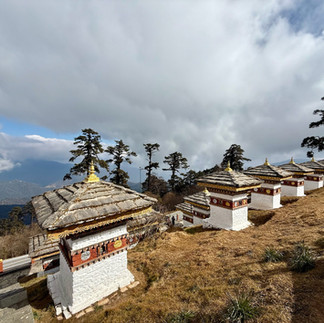
Dochul Pass
Their famous street cops - no traffic lights in the entire country






Bishnu spinning a monster prayer wheel - I think his prayer was "Please don't let that old guy die on this hike"


































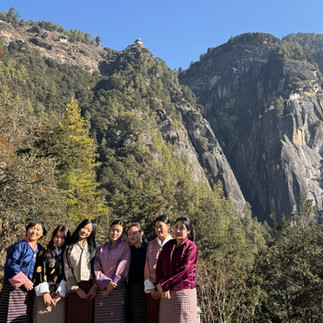
Paro Taktsang (Tiger's Nest)










I wasn’t entirely sold on Bhutan before we decided to go for the simple reason that it was expensive and they require you to pay a nightly fee to stay in the country. I am a bit of a cheapskate and pre-decided that the extra expense was not worth it, regardless of how beautiful the country is. Bad move and as usual, wife is right about these things. Bhutan charges $200 USD per person per night ($400 per night) in the high season and $100 PPPN ($200 per night) in the low season. They also don’t let anyone into the country without a govt licensed tour guide and driver, so another few hundred $ per day. Fortunately we were there in the exact center of the low season, so the govt rate was half price and the guide rates were lower and the packages came with all transport, lodging and food, so really not a bad deal. Typically, we like to make our own way around but the driver (Tshering) and guide (Bishnu) proved invaluable and we really liked them as well, so a major bonus. Having a guide was also having a personal Wikipedia on all things Bhutan, as Bishnu's knowledge of the country and Buddhism was amazing. Also, the roads are good but having both a guide and an amazing driver allowed us to completely enjoy the scenery and focus on random Buddhism questions and the beautiful scenery rather than dodging yaks and takins (the national animal - sort of like goat cow deer crossover model). After weeks in India it was a foreign experience to have a driver that didn't try to take the curves at breakneck speed and actually let people pass. The only time he honked was to say hello to someone he knew.
Here's a quick rundown on the country in case you've never heard of it before:
Bhutan is completely landlocked and surrounded by the two largest populations in the world, India and China. If you look at it on the map you realize that India developed some interesting borders when it incorporated in 1947 and surrounds Bhutan on three sides, with China on the northern Himalaya mountain border. Much of it sits in the Eastern Himalayas but the mountains are considered sacred ground and are off-limits to trekkers, leaving Bhutan with a few of the tallest unclimbed mountains in the world. Until 75 or so years ago it was mostly cut off from the modern world. The then-King, the grandfather of the current King, was quite forward thinking and decided it needed to join the rest of the world, so they entered NATO, partnered with neighboring India and Nepal, and began a focus on education while staying true to their Vajrayana Buddhist culture. They built a nice little Intl airport, improved the infrastructure, including roads and services and seem to have developed a population that is proud of their country and happy to show it and their Buddhism off to the rest of the world. Especially the paying tourist kind.
Bhutan is largely famous for four things - being one of the only (maybe only) Carbon Negative countries in the world, their interesting measurement tool, the Gross National Happiness index, switching from a Monarchy to a Democracy and The Tiger’s Nest.
The country makes most of its money in hydroelectric power from the numerous Himalayan rivers it controls (it sells a lot of power to India) and then tourism, which is growing each year. The GNH is built upon four corners, the preservations of Culture, Environment, Social Economic Development and Good Governance. We had quite a few conversations on the methodology, independence and how they rank everything. Some of the measurements seem tough to quantify and could be rife for manipulation, but apparently the King appointed an entirely independent agency to monitor, survey and rank everything. The simple fact that they value Happiness over profits amazes me the more I think about it. It’s possibly chasing a unicorn, but beautiful nevertheless.
Additionally, about 20 years ago the King developed a constitution to turn over government functions to a representative democracy, thereby abdicating Monarchical rule in everyday life. The King still maintains a large role in the country and works quite a few initiatives for the betterment of the people but has relinquished control to the 20 state leaders. With a population of only 700K and just one religion it is a little easier to manage this type of transition, but the forethought and caring for the people to undertake this change seems heroic to me. The people we talked to all revered the monarchy and some even hoped to return to monarchical rule due to growing pains in the political process, but it all seems to work for this country. Everywhere we went the pictures of the young King and his family were plastered in prominent positions. While I’m sure there are issues we couldn’t see, it appeared to be working here and people truly were happy.
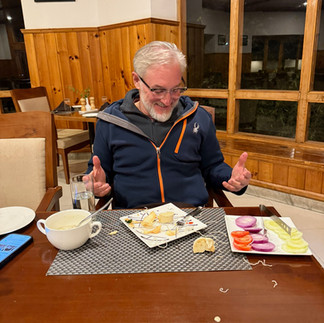
I’ll get to the Tiger’s Nest shortly, but first the negatives, which are short. I only have two gripes about the country - the food and the no-cameras in temples policy. Being surrounded by India and China and with Nepal almost next door, you’d think the food would be much better. Unfortunately, they still have the same adherence to fire (spicy foods) the other countries have but without the additional flavors. So we ate basically the same foods every day - a ton of rice, some stir fried veggies, fried veggies, and then a couple of meat dishes. While I loved the vegetables, they only really had 5 or 6 dishes they served for tourists. And in talking to people, their normal diet didn’t differ much from what we were served daily. Fortunately crops and growing regions are plentiful so hunger isn’t an issue, but there wasn’t much variety. Their national dish is chili cheese, which is not to be confused with American Chili with cheese. This was basically cut up nuclear chili slices cooked with soft white cheese. I think the cooking was actually done without fire and simply by the damned chilis - they laughed at me that I couldn’t barely eat the baby version without gulping a ton of water. I had more runny noses in Bhutan than the rest of the world - solely due to those chilis. On the flip side, they did have the best fried eggplants I’ve ever had, though. There are a couple of pics of the food and it really didn’t differ much from day to day. But once you see the country it's easy to forget about the food - the country and people simply blow your mind.
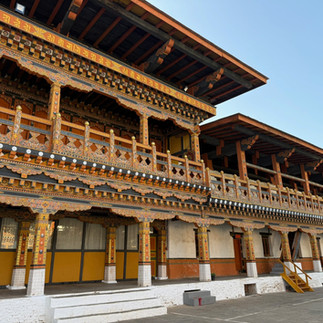
My other gripe is selfish but I understand the policy. They don’t allow cameras in the temples. Basically, as soon as you take your shoes off to enter a temple you have to pocket your phone. And in some places it’s completely taken from you. I understand this since they are temples and holy, but the insides of the temples are so amazing it’s a shame to not be able to share them. Also, there are like a thousand different buddha’s in some, tables of food and gifts left as offerings and hundreds of other little and some huge items to gawk over. And I truly wish I could share the inside of the Temple of Chimi Lhakhang, also known as the Temple of The Divine Madman. This enlightened monk was basically the drunken monk you picture in some old Chinese Kung-Fu movies, but his particular brand of Kung-Fu was in the bedroom, after bit of whiskey. His priestly “scepter” is adorned all over the temple and the surrounding villages and it’s considered the temple to pray for fertility. The temple and much of the surrounding area is all about phalluses (phalli???). Young couples come to pray for a baby, with the woman required to take a Walk of Shame around the temple three times, wearing a Phallus Backpack. Yes, I am serious. There was a young woman walking with a three foot wooden schlamonguous backpack attached to her back (see picture) apparently hoping for a baby. Wish I had some pics to share of the inside of this place!
The biggest and most iconic draw of Bhutan is the Paro Taktsang (Tiger’s Nest Monastery). It was built in the 1600's to be the backdrop for the Cristian Bale Batman movie and has been in some other directly referenced movies as well. It’s a beautiful group of temples nestled about 10K feet up on a cliff, roughly 3K feet above the valley below. For us, it took about a two hour hike up the mountain to get to - it was a great but strenuous trail and offered some truly magnificent views along the way. It amazes me that these crazy assed monks would build a temple so far out of the way and hard to get to. I can’t imagine the journey it took people 400 years ago, in sandals without Vibram soles, without nice rock or cement steps, and with no nice cafe to greet you halfway. I think the hike and the views from outside were better than the actual temple inside - it’s not as opulent as other easy-to-reach temples we visited but the unique location on the side of a cliff makes it so much more attractive to get to.
Some other highlights for me were the Dochula Mountain Pass, sitting at just over 10K feet; the Buddha Dordenma statue (one of the world’s tallest Buddha’s at 177 feet) and lucking into a village celebration on one of our mountain temple hikes. The celebration was for the Bhutanese Traditional Day of Offering so the local villagers got together and played the neighboring village in darts. This wasn’t anything close to pub darts. They played outside on a rice paddy with darts that looked like they were a foot long and weighed a kilo or so. The targets (a 2 X 6 board about a meter tall) were about 100 meters from each other, with teams at each end. The players hurled them across the field and got colored sashes if you stuck the dart into the wood. Each time they got a bullseye the players all performed a song and a little dance at each end of the pitch. It was really fun and quite lucky to happen upon and we stuck around for 30 or so minutes. As we were leaving to continue our hike (around 10 in the morning) the alcohol was getting delivered. Bishnu said they would end up playing all day and then also drinking all day as well. I really wanted to be there later in the afternoon to see how good their aim was after the case of whiskey got closer to empty. During the hike over the next couple of hours we could hear their victory songs all the way up the mountain, where we visited yet another amazingly beautiful temple.
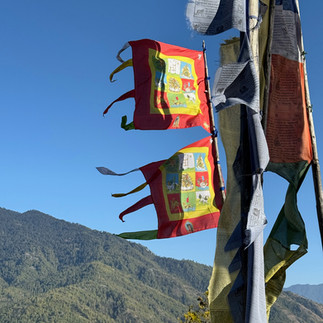
It’s tough for me to think of a more beautiful and peaceful place in the world. One day we visited the Chele La mountain pass leading to the Haa Valley, about 13K feet up. It struck me, as I sat there looking out over the Himalayan expanse, of how calming and quiet it was. No birds, no people, no cell phones and no friggin car horns. I could barely hear the sound of the prayer flags in the breeze. I think this must be what my friends Julie and Shane must experience everyday in Colorado - just beauty. Guess this is why people started meditating up here. I really didn’t want to leave…until the only other person on the summit started FaceTiming with someone at full volume…technology sucks sometimes!
It's tough to describe the beauty of Bhutan. Between the mountains and the temples and the people it's a place I'd easily return to. And the temps in the winter weren't bad - it was cold in the mornings and after the sun went down but during the days it hovered around 70 f, so really comfortable.


Comments